

Elderly people often live in a retirement or nursing home when their state of health no longer allows them to remain at home, even with the support of relatives and/or home care services. For this group of people, the «Roadmap for the implementation of advance care planning (ACP) in Switzerland» recommends a detailed or disease-specific ACP.
People in long-term care institutions are an important yet vulnerable group when it comes to ACP. Also in this setting, a person should have the opportunity to decide autonomously how they would like to be treated and cared for in the event of future incapacity. Studies have shown, however, that implementing ACP in retirement and nursing homes is challenging, for example because many elderly people are still largely unfamiliar with advance directives. Another challenge is that the need for long-term care is expected to increase by 50% by 2040. Read more: Obsan report 09/2025 in German (with a management summary in French).
People in retirement and nursing homes are a particularly important group for whom ACP should be strengthened. In particular, people with multimorbidity, increasing frailty and/or early dementia should be given the opportunity and support to reflect on their personal values and therapeutic goals. Their wishes should be put in writing, if they so choose, and made available to their caregivers.
ACP enables individuals to reflect on and document their personal wishes for or against specific medical interventions in the event of incapacity. Advance directives are the best-known instrument for this purpose, and it is recommended that anyone capable of making decisions completes such a document. When a nursing home resident is not, or no longer capable of making decisions, their therapeutic representative plays a central role. In addition to advance directives, other APC instruments are available.
Guidance for professionals in retirement and nursing homes
An interprofessional sub-working group commissioned by the national working group ACP has developed a brochure to strengthen ACP in retirement and nursing homes. It serves as a practical guide to support professionals in implementing ACP in this setting. The brochure is intended for all professionals working in long-term inpatient care institutions, in particular nurses, doctors and ACP consultants. Its aim is to ensure that ACP is understood and integrated into the daily work of nursing homes, for the benefit of residents. The brochure is available in French, German and Italian, in PDF format or in paper form.
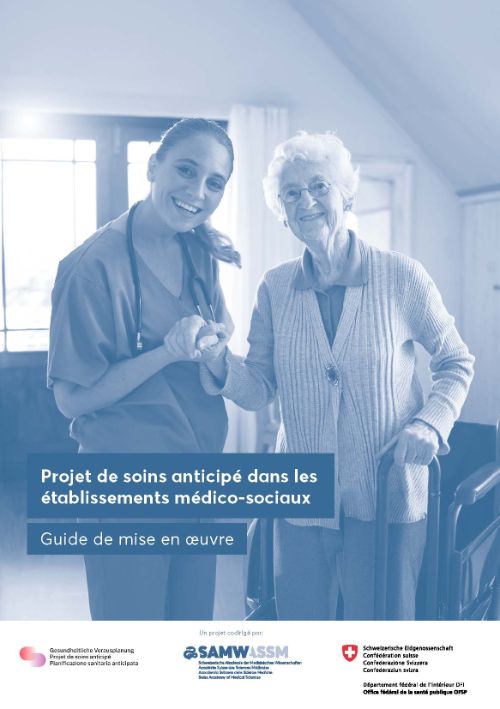
In six steps, the when, what and how of ACP are described. Planning ahead for health in nursing homes is a continuous process between residents, professionals and, where applicable, relatives. Elderly people should be offered the opportunity to begin this process upon admission to the home. If residents wish to do so, they are supported in reflecting on their personal values and wishes regarding medical treatment. These matters are then discussed together and put in writing. This includes setting treatment goals and the desired level of treatment intensity in the event of a deterioration in health or in emergency situations. If a person is not capable of making decisions, the therapeutic representative is involved.
Call for feedback: Form treatment intensity
To document treatment goals and the desired level of treatment intensity, the working group recommends using a standardized form, even if the person already has an advance directive or treatment plan. This additional document summarises the most important information for emergency situations on a single page. The form can be used to facilitate communication between the nursing home, the emergency services and the hospital.
A preliminary version of the recommended form – in German, French and Italian – is available for a pilot phase:
- Formulaire sur le degré d’intensité de traitement (présumé) souhaité dans l’EMS et en cas d’urgence (Version pour la phase pilote) PDF, 313 KB
- Formular zur (mutmasslich) gewünschten Behandlungsintensität im Heim und bei Notfallsituationen (Version für die Pilotphase) PDF, 317 KB
- Formulario sull’intensità di trattamento (presumibilmente) desiderata in istituto e in situazioni di emergenza (Versione per la fase pilota) PDF, 264 KB
Share your professional experience
All professionals and institutions using the form are invited to share their experiences. Survey responses will be reviewed and taken into account in the further development of the tool. The survey is available in French and German:
ACP as a medical quality indicator
On behalf of the «Commission fédérale pour la qualité (CFQ)» (Website available in French or German), the national implementation programme «Qualité des soins de longue durée dans les établissements médico-sociaux (NIP-Q-UPGRADE)» is underway. The programme focuses on data-based quality of care. Numerous quality indicators have already been successfully introduced. In autumn 2025, «advance care planning» was launched as an additional medical quality indicator and its practical implementation was tested. The implementation and documentation of ACP in retirement and nursing homes plays a central role in this. More about NIP-Q-UPGRADE in French or German.
The brochure provides important information on this topic. The «Commission fédérale pour la qualité (CFQ)» is expected to decide on the definitive national introduction of a «ACP» quality indicator in 2027.
More information
- Offres de formation post-graduées et continues sur le projet de soin anticipé en général (in French, German and Italian) PDF, 179 KB
- «Accompagner la vie et la fin de vie», Ursula Arn et Reka Schweighoffer, membres du sous-GdT et du GdT ProSa, le magazine Artiset 9/2025 (in French) PDF, 166 KB
- «Das Leben und das Lebensende gestalten», von Ursula Arn und Reka Schweighoffer, Mitglieder der Sub-AG und AG GVP, im Magazin ARTISET 9/2025 (in German) PDF, 317 KB
- Bulletin de l’ASSM 2/2024: «Projet de soins anticipé: plus-value confirmée par un sondage» (in French) PDF, 41 KB
- SAMW Bulletin 2/2024: «Umfrage Gesundheitliche Vorausplanung: Mehrwert für Pflege klar bestätigt» (in German) PDF, 34 KB